Article
ESG reporting for consultancies: scaling services under CSRD and ESRS
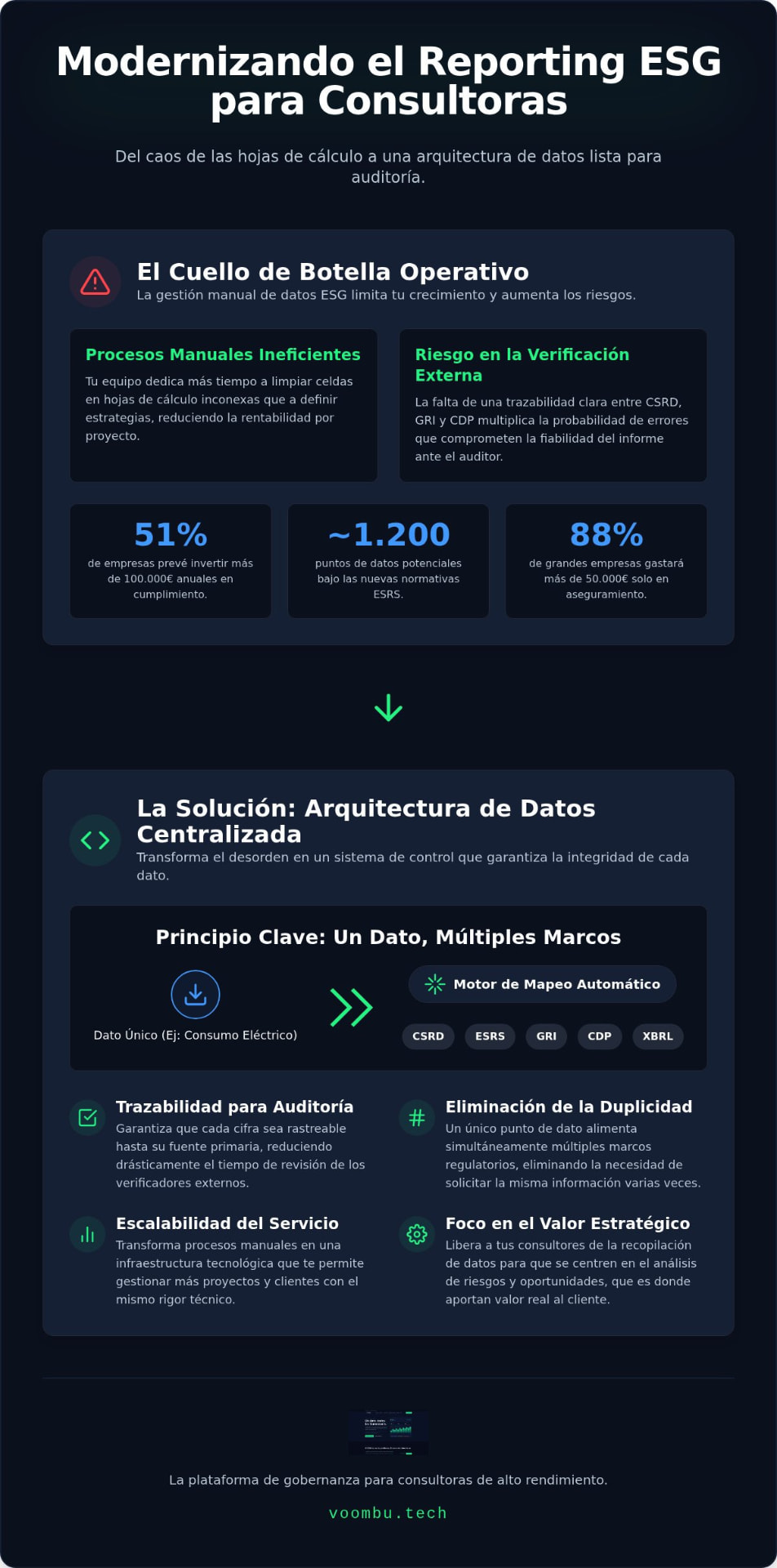
More than half of companies —51%— expect to allocate over 100,000 euros a year to regulatory compliance. Yet much of that money ends up funding the same old processes: spreadsheets emailed back and forth, versions nobody can identify as definitive, and a senior consultant billing by the hour while reconciling cells at eleven o'clock on a Thursday night.
If that scene sounds familiar, the problem is not effort. It is architecture.
ESG reporting for consultancies stopped being an editorial task a couple of years ago. It is no longer about designing an attractive report in InDesign: it is about maintaining a data structure that can withstand external verification, with the Omnibus I Directive on the table and an auditor asking exactly where that figure on page 47 came from. Anyone who has tried mapping indicators between CSRD, GRI and CDP manually knows how fragile that chain is.
This guide shows you how to move from a manual approach to infrastructure that lets you handle more projects per consultant without compromising rigour. We will discuss a single semantic model, automatic regulatory mapping, integrating financial and non-financial risks under COSO ERM, and what delivering an audit-ready report means in practice when the XBRL taxonomy takes effect.
Key takeaways
- Disconnected spreadsheets are your firm's real ceiling: they do not limit the quality of analysis, but the number of clients you can serve.
- A single semantic model lets you capture data once and map it to CSRD, ESRS, GRI or SASB without requesting it again.
- Without traceability back to the original evidence, external verification becomes an exercise in documentary archaeology.
- Integrating risk management under COSO ERM connects ESG performance to the balance sheet, which is the language the CFO speaks.
- Scaling does not mean hiring more people, but reducing administrative hours per project.
Table of contents
- The operational bottleneck in ESG reporting for consultancies
- Data architecture: the single semantic model
- Regulatory mapping and technical formats: CSRD, ESRS and XBRL
- Traceability and risk management: preparing for external verification
- Voombu: data governance for consultancies
- Frequently asked questions
The operational bottleneck in ESG reporting for consultancies
Let us do the maths. A senior consultant costing 90 euros an hour who spends two full days cleaning a client's data represents around 1,400 euros that the client does not perceive as value and that you cannot bill as analysis either. Multiply that across your portfolio. That is the margin evaporating into sustainability reporting tasks that no manual methodology can absorb as volumes grow.The underlying problem is more uncomfortable than the cost. When information is scattered across emails, shared folders and files with names like datos_v3_FINAL_ok.xlsx, you are accumulating sustainability technical debt. The report may be correct. But you cannot demonstrate it. And during external verification, the difference between being right and proving it costs weeks of work.
Industry figures help put this into perspective: the ESRS contain around 1,200 potential data points, and 88% of large companies expect to spend over 50,000 euros on assurance processes alone. No team, however capable, can manage that sustainably by hand.
And here is the paradox: your value was never in collecting electricity invoices or waste management delivery notes. It lies in understanding the financial risk behind those numbers and telling the client what to do about it. Everything else is infrastructure, and infrastructure can be automated.
What changes when you modernise the service
The first change is conceptual: you stop thinking about documents and start thinking about workflows. A data point enters once, is validated once, and feeds every framework that needs it. When a new regulation arrives —and it will— you do not start again from scratch.The second concerns positioning. A report whose figures can be traced back to their primary source reduces the verifier's time and changes the conversation with the client along the way. You stop being the annual report supplier and become the partner supporting their data governance. Those are two very different contracts, and the second is what turns ESG reporting for consultancies into a recurring service.
Data architecture: the single semantic model
The traditional ESG consulting pattern is reactive. A new framework appears, the team prepares another data request template, and the client receives a third request that looks suspiciously like the previous two. With slightly different details, admittedly. Different enough to prevent reuse, and just enough to make the client's sustainability manager start responding late.The technical alternative can be summed up in one sentence: one data point, multiple frameworks. Information is structured under a common ontology and mapping stops being manual work. A plant's electricity consumption is captured once, with its unit, period and evidence, and the engine maps it wherever required.
This matters especially with the Corporate Sustainability Reporting Directive (CSRD), whose difficulty lies not in the concept but in the granularity. More than 1,100 potential data points under ESRS turn any manual process into a lottery. Automating mapping to GRI or SASB is not a technological luxury: it is the only thing that makes the volume manageable.
Organising non-financial information ultimately demands the same discipline as financial accounting. Defined categories, accountable owners, period-end closes. The added advantage is that the knowledge currently held in your consultants' heads —and lost when they change jobs— becomes a firm asset. If you are considering how to make that transition, an ESG data governance platform handles much of the underlying plumbing.
How implementation works in practice
Start with evidence, not indicators. Every figure needs supporting documentation: the invoice, the waste contractor's certificate, the committee minutes. If these are centralised from the outset, verification stops being an inbox treasure hunt.Define who validates what. Data is the responsibility of whoever generates it within the client company; your team provides oversight. That may sound like a minor organisational detail, but the opposite is true: it prevents the consultancy from taking on risks that are not its responsibility.
Finish with weighted scoring. E40 / S35 / G25 weights let the executive committee see performance and risk on a single screen. That is where your advice moves from compliance into financial strategy.
Regulatory mapping and technical formats: CSRD, ESRS and XBRL
The difficulty with ESRS is not their length, but their format. The report has stopped being a designed PDF and become a tagged document that a machine must be able to read. According to EFRAG's roadmap, the definitive XBRL taxonomy will be delivered in December 2026, after which that data is destined for the European Single Access Point (ESAP).In plain terms: a report that cannot be processed digitally is non-compliant. However well written it is. That is why ESG reporting for consultancies now requires data architecture skills that nobody was asking for three years ago.
For a consultancy, efficiency depends on being able to map the same dataset to several frameworks simultaneously. A decent mapping engine covers the disclosure obligations for EU and non-EU companies without duplicating processes, and eliminates a familiar problem at its root: the GRI number differing from the CDP number because somebody updated one spreadsheet but not the other.
What each framework requires
- ESRS (CSRD). Mandatory double materiality and strict iXBRL tagging. By far the most technically demanding.
- It remains focused on stakeholder impacts and allows more sector-specific flexibility. Its interoperability with ESRS is what prevents reporting the same metric twice.
- EU Taxonomy. This classifies economic activities. It requires turnover, CapEx and OpEx to align with specific technical screening criteria, which is where surprises tend to emerge.
Managing double materiality with software
The materiality matrix determines which data points are mandatory for each client. Automating it removes subjectivity from the process and, above all, makes it defensible: the system links the matrix results to the corresponding ESRS indicators, leaving nothing out through oversight.There is one detail many teams overlook. Before a verifier, justifying the topics you considered material is not enough; you must also explain why you excluded the rest. Specialist software stores that technical justification alongside the matrix. This turns a qualitative analysis into a repeatable, auditable process.
Traceability and risk management: preparing for external verification
Traceability determines whether a report stands up or falls apart. In ESG reporting for consultancies, without a chain of custody from the original invoice to the consolidated KPI, any verifier finding means reworking material, while the risk of inadvertent greenwashing —arising from misinterpreted data rather than bad faith— increases sharply.Then there is the other half of the equation: risk. Integrating management under the COSO ERM methodology lets the CFO see the financial impact of environmental and social factors in familiar terms. Reporting Scope 3 emissions is no longer enough; what matters is what happens to the balance sheet and supply chain when the carbon price moves. To automate that control, an ESG risk module aligned with recognised internal control frameworks saves considerable coordination work.
A traceability framework that works
The minimum requirement is an audit trail answering three questions for every indicator: who changed it, when and why. Every data point linked to its documentary evidence, accessible in seconds.The benefit is not merely defensive. When you give the auditor an already structured working package, support hours during verification fall sharply. And those hours were coming out of your margin.
The connection with sustainable finance
ESG performance influences the cost of capital, and that is no longer a brochure claim. A well-constructed ESG Score —with E40, S35 and G25 weights— helps anticipate access to green financing, with documented effects of between 5 and 15 basis points on the cost of debt.Aligning scoring with MSCI or Sustainalytics methodologies also has a political advantage: the executive committee immediately understands where it stands against peers. And when reporting starts being seen as a financial lever rather than an obligation, your position at that table changes.
Voombu: data governance for consultancies
Voombu is the infrastructure that enables an advisory firm to increase project numbers without a proportional rise in administrative hours. It is designed for the mid-market and consultants managing portfolios of very different clients: multiple environments within one account, granular team permissions and real-time visibility across all projects.The regulatory mapping engine is the heart of the system. It maps captured data to more than 16 international frameworks, so a new requirement does not mean redoing the client's work. The 1,100 ESRS data points become the platform's problem, and your team recovers time for work that can actually be billed as analysis. That is the difference between handcrafted ESG reporting for consultancies and an industrialised approach.
What it includes
- Single semantic model. Capture once and generate reports aligned with ESRS, GRI or SASB.
- Dynamic ESG Score. E40/S35/G25 weighting and comparison with the logic used by rating agencies.
- ESG risk module. COSO ERM methodology connecting sustainability to the corporate risk map.
- Audit-ready outputs. Word, PDF and XBRL documentation ready for the verifier, without the usual bottleneck in the project's final week.
The effect on the client relationship
Executive dashboards do something that looks simple but is actually difficult: translate technical data into decisions. The CFO sees the financial impact of non-financial indicators and approves investments on a better-informed basis. You are seen as the person who brought order.And in day-to-day operations, shorter reporting cycles quickly show up in the income statement. Less manual work means more projects per consultant with the same team. Voombu does not replace your expert judgement —that cannot be automated— but provides the infrastructure needed to sustain the volumes coming with ESAP.
Lead the transition towards data-driven ESG consulting
The spreadsheet-based model has hit its ceiling. Not because teams lack talent, but because European regulation now demands precision and digital traceability that no spreadsheet can guarantee.Throughout this guide, the same thread has emerged: capture data once, map it automatically, leave a trail of everything and connect the result to the client's financial risk. That is the transition that turns ESG reporting for consultancies into scalable infrastructure rather than a service that gets stuck.
If you want to see how it works with your own portfolio, request a Voombu demo and discover how much of your manual work disappears.