
Article
ESG data management platforms: a selection guide for companies in 2026
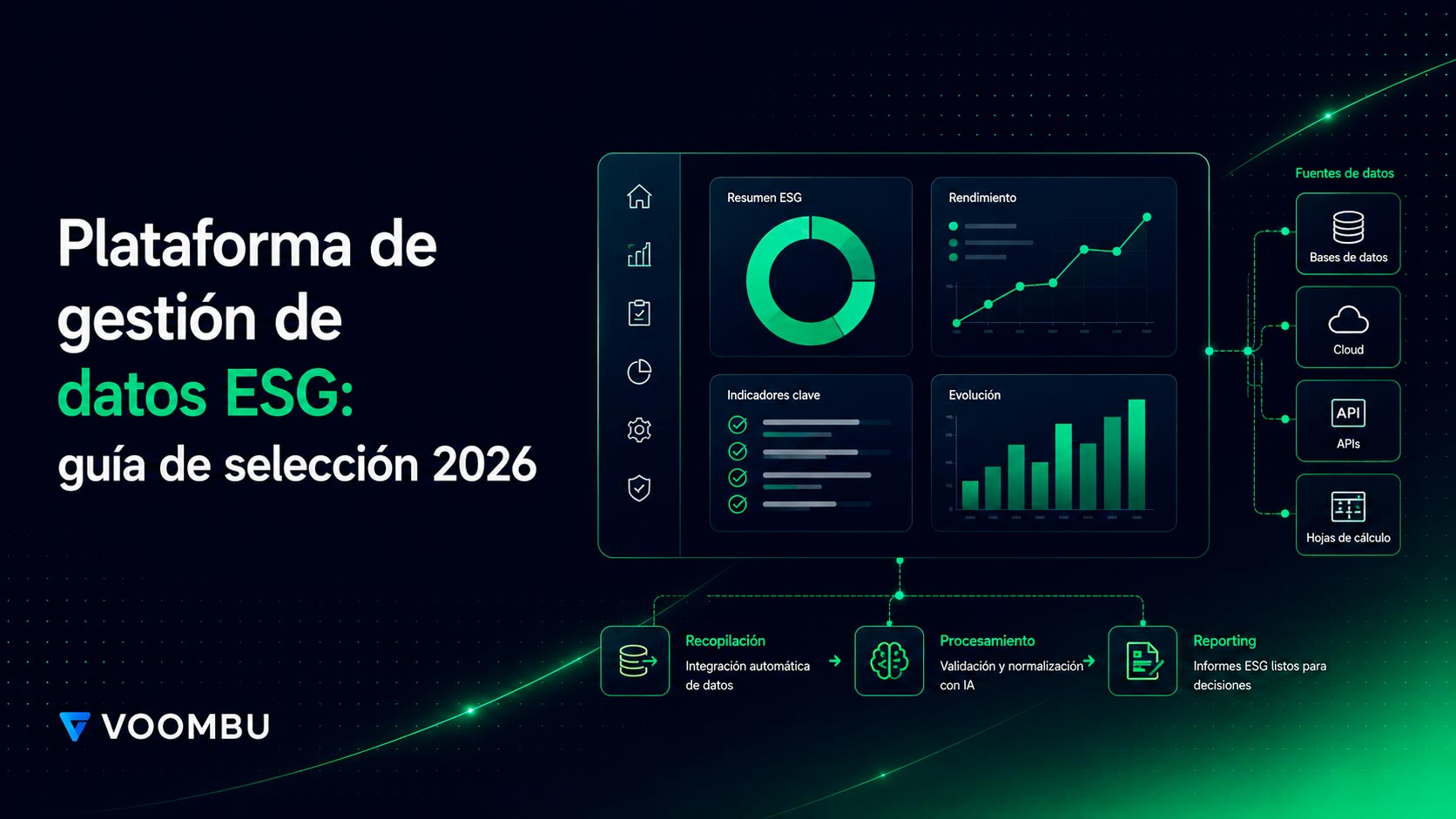
Choosing an ESG data management platform is not a software decision. It is a governance decision. What we decide in 2026 will shape, for several years, how we capture, validate and report information that is no longer optional: carbon footprints, ESRS datapoints, material risks, social metrics and supply chain data. This guide is intended for the team —finance, sustainability and IT— that must make that decision without being swayed by the sales demo or paralysed by excessive caution.
Key points
The spreadsheet stops scaling when there is more than one operating country, more than fifty significant suppliers or more than one reporting framework. It works in the first year; not in the second. There are three families of platform: modules built on an existing ERP, dedicated ESG platforms and boutique consultancy solutions. Each addresses a different scope. Technical criteria matter, but governance criteria —audit trails, version control, COSO ERM integration— determine whether the tool survives its first audit. The hidden cost lies in integration with operational systems (ERP, HR, procurement) and maintaining up-to-date emission factors, not in the licence. A sensible rule: a platform the auditor understands without difficulty is a good platform; anything else is a problem that has not yet surfaced.
Table of contents
- Why the spreadsheet stops working
- Three platform families and what each is for
- Technical evaluation criteria
- Governance criteria many comparisons overlook
- Three-year total cost of ownership (TCO)
- How Voombu fits into this category
- Common selection mistakes
- Frequently asked questions
1. Why the spreadsheet stops working
Every company beginning to manage ESG starts with Excel. That is reasonable: the tool is flexible, the initial cost is zero, and the first reporting cycle can be organised with an external consultancy in a few weeks. The spreadsheet is not bad; it is the next step that is difficult.
The usual symptoms from the second year onwards:
Several versions of the same data circulate by email and in shared folders. It is impossible to know which is the master version. Emission factors are updated in one tab but not in others. The previous year's figures no longer reconcile with the current version. The consolidation boundary changes (a subsidiary is acquired, a unit is sold) without being reflected retrospectively. The auditor asks why the comparative data does not match. Time spent on reconciliation grows faster than the team. What took two people two weeks in the first year takes four people two months by the third. It is impossible to explain the origin of a specific data point to the auditor. Documentary traceability is missing. None of these problems is strictly technical. They are data governance problems. Excel is designed for flexible analysis, not governance. That is why finance departments stopped using it for consolidation twenty years ago. ESG is following the same path.
2. Three platform families and what each is for
Sustainability module on an existing ERP The major ERPs (SAP, Oracle, Microsoft Dynamics) have incorporated ESG management modules. For companies already operating within one of these ecosystems and investing in its maturity, this is a coherent option. Advantages: native integration with operational data and a single source of truth. Disadvantages: methodological rigidity, dependence on the vendor's update schedule, significant licence and consultancy costs, and difficulty adapting to emerging frameworks.
Dedicated ESG platform (best-of-breed) Software built specifically to calculate, store and report ESG information. It integrates with the ERP and operational systems, keeps the emission factor database up to date, supports several methodologies in parallel and produces a native audit trail. Advantages: scalability, rapid updates in response to regulatory changes and an audit trail designed for verification. Disadvantages: it requires an integration project and depends on the vendor's maturity.
Boutique consultancy solutions Some specialist consultancies offer proprietary tools for their customers, sometimes with a perpetual licence and sometimes as part of a recurring service. Advantages: close methodological support. Disadvantages: dependence on the provider, difficulty migrating if the relationship ends and limited capacity for technical evolution.
No family excludes the others. The usual approach in mid-market companies is to hire a consultancy in the first year to support implementation, operate with a dedicated platform from the second year onwards and retain the ERP as the operational system of record for primary data.
3. Technical evaluation criteria
Supported frameworks The platform should natively support the frameworks the company needs now and will need over the next three years: CSRD/ESRS, GHG Protocol (Scopes 1, 2, 3), EU Taxonomy, SFDR where applicable, CDP, TCFD, GRI and ISSB. For mid-market SMEs, support for VSME and standardised banking questionnaires (PCAF) is also advisable.
System integration Connectors to the most common ERPs (SAP, Oracle, Microsoft Dynamics, Sage), human resources systems, procurement platforms, APIs, and invoices or documents with AI-assisted extraction. Without integration, the platform becomes a sophisticated Excel spreadsheet. With integration, it becomes a single source.
Emission factor database Centralised maintenance of DEFRA, ADEME, IEA, ecoinvent and specific sector databases. The platform must record which factor was applied to each calculation and allow recalculation using the historical factor when an audit requests it.
Dual-method capability (spend-based + activity-based) For Scope 3 of the carbon footprint, the platform must allow spend-based calculation to cover the complete boundary and progressive replacement with activity-based calculations for significant categories and suppliers. Without this coexistence, the first year is spent calculating and the second rewriting everything.
Report generation in regulatory format ESEF for CSRD, with XBRL tagging following the ESRS taxonomy. Templates for CDP, GRI and VSME. The ability to export structured responses to banking questionnaires.
Artificial intelligence applied with judgement AI is useful for accelerating data upload and validation (invoice classification, anomaly detection, suggested factors), but regulatory calculations must be deterministic and auditable. A platform that uses AI where it adds value, not where it adds risk, is a good platform. One selling generative AI to produce the report is a red flag for the auditor.
4. Governance criteria many comparisons overlook
Audit trail by design Every recorded data point must have complete traceability: data origin, calculation formula, factor applied, upload date, responsible person and subsequent changes. Without an audit trail, an audit is impossible. Limited assurance under CSRD will check this.
Data version control The ability to establish which figure was published in the previous reporting year and reconstruct how the current figure was reached. This is essential for reconciling comparative data and responding to retrospective adjustments caused by boundary or methodology changes.
Roles and permissions Who can upload, who can approve and who can make changes after approval. A platform without segregation of duties turns any user into a single point of failure.
Integration with risk under COSO ERM ESG information is an input to the risk management system. If the ESG platform and risk system operate in silos, the company duplicates work and loses consistency. Native integration with a risk matrix using COSO ERM methodology closes that gap.
Reconciliation with finance The ESG consolidation boundary must be reconcilable with the financial boundary. Any difference (subsidiaries not consolidated financially, joint ventures, minority interests) must be explainable. Without that reconciliation, the financial report auditor and the ESG report verifier are talking about different companies.
Data security and residency ISO 27001 as a minimum, EU data residency, GDPR compliance, backups and a continuity plan. These are baseline requirements, but not every platform provides them to the same standard.
5. Three-year total cost of ownership (TCO)
The licence is the visible part of the cost. Total cost consists of five components.
Software licence. This depends on the model (per user, per entity, per module). For mid-market ESG platforms, the usual range is an annual investment tailored to the scope of a company operating in one or two countries with a single consolidation group.
Implementation and integration. A one-off cost in the first 6-12 months. It includes ERP connections, methodology configuration and user training. Typical range: €30,000-120,000, depending on ERP maturity and the number of sources to integrate.
External consultancy support. Variable. For companies starting out, the first year usually adds a further investment in targeted consultancy on methodology, double materiality and validation. This decreases year by year.
Internal time commitment. The most underestimated cost. A mid-market company devotes between 0.5 and 2 internal FTEs to ESG operations. This is a real cost and must be recorded.
Technical maintenance and regulatory updates. Included in well-managed SaaS platforms, but not included in ERP modules where updates depend on the vendor's schedule.
For mid-market companies, the three-year calculation favours a dedicated ESG platform. For large corporations with established SAP or Oracle environments, the ERP module may be the best option if the module is sufficiently mature. For SMEs with fewer than one hundred employees and simple operations, a well-structured spreadsheet combined with targeted consultancy support remains reasonable.
6. How Voombu fits into this category
Voombu is a dedicated ESG platform, powered by artificial intelligence and designed specifically for mid-market companies and consultancies serving that segment. The product thesis is straightforward: within this scope, a company needs neither the cost of a module built on SAP nor the rigidity of a spreadsheet. It needs a platform that connects operational data, automates calculations and produces traceable reporting.
The platform is structured around four integrated pillars:
Automated reporting. Supports CSRD/ESRS, VSME, GHG Protocol (Scopes 1, 2, 3), EU Taxonomy, SFDR, GRI and CDP. Loads data from ERP, HR and procurement. Generates ESEF with XBRL tagging.
ESG risk management under COSO ERM methodology. A 5×3 matrix integrated with the rest of the system. Risks consume operational data from the reporting module and produce a consolidated view.
Dynamic ESG Score. A weighted indicator (Environmental 40 %, Social 35 %, Governance 25 %) that evolves in real time and can be linked to internal KPIs or sustainable financing terms.
Executive dashboard. A single view for management and the board, with drill-down to the original data and audit-ready export.
For specialist ESG consultancies, a multi-licence model (MLC) allows multiple customers to be managed through shared infrastructure while maintaining data separation and visual customisation.
7. Common selection mistakes
Choosing based on the demo. The demo shows the attractive parts. Request real cases, data from similar companies and references you can contact. A demo without access to references is a risk. Underestimating integration. 70% of projects that fail do not fail in the platform; they fail in the connection to ERP, procurement and HR. Audit that component before signing. Buying based on the brand. Large consultancies sell decent platforms at high prices. Dedicated mid-market platforms usually offer better value for money if the company fits that scope. Not involving the auditor. The verifier who will sign the report has an opinion on which platforms are understandable and which are not. Consult them before choosing. Forgetting comparative data. The current reporting year and the next coexist. The platform must maintain consistency with the previous methodology or document the change without breaking the series. Relying on generative AI for reporting. AI accelerates upload and validation. Regulatory reporting must be deterministic. Any tool promising to generate the report automatically with AI will have problems with the auditor.
8. Frequently asked questions
How long does implementing an ESG platform take? For a mid-market company operating in one or two countries with one consolidation group, between three and six months from signing to the first complete reporting close. The critical factor is not the software; it is the availability of the people responsible for each area to connect sources and validate data.
Can I migrate from spreadsheets to a platform without losing historical data? Yes. Historical data loading forms part of the implementation project. The requirement is that the historical data has minimum traceability (data origin, factor applied, date). If the spreadsheet lacks even that, the sensible assumption is that the usable series starts with the first reporting year on the platform, while historical information remains as documentary reference.
Is SaaS or on-premise better? SaaS in the overwhelming majority of cases. Regulatory updates are continuous and can only be sustained through a software-as-a-service model. On-premise makes sense only in companies whose internal policies require it, normally in highly regulated sectors or where data is extremely sensitive.
Does the platform cover the EU Taxonomy? A serious ESG platform should cover it. The Taxonomy requires reporting the proportion of turnover, CapEx and OpEx corresponding to eligible and aligned activities. Without that capability, the company ends up handling the Taxonomy in a separate spreadsheet, with all the associated problems.
What happens with the audit? Limited assurance under CSRD reviews the report and the audit trail. A platform producing a native audit trail significantly reduces audit cost and risk. The difference between a platform with a good audit trail and one without can be in the region of 30-50 % of auditor hours.
What about bringing in investors? Institutional investors conduct ESG due diligence. A company arriving with structured data in a defensible platform moves through due diligence faster and with less friction. This is one of the less obvious returns on a good choice.
Does Voombu compete with SAP or the large consultancies? It competes and complements. For large companies already operating on a mature SAP environment, the SAP module may be the best option. For mid-market companies and consultancies serving that segment, Voombu addresses the use case better. Every tool has its natural scope; the important thing is to choose the one that fits the company's reality.
Next steps
The ESG platform decision is neither urgent nor impossible. The sensible approach in 2026 is to devote one or two months to a well-run selection process: define requirements, request references and conduct a limited trial using real data. Voombu is happy to participate in structured selection processes, with access to customers who can share their experience. A 30-minute demo is usually enough to establish whether the platform fits the specific use case.