
Article
Sustainability roles: organisational structure and responsibilities for ESG reporting in 2026
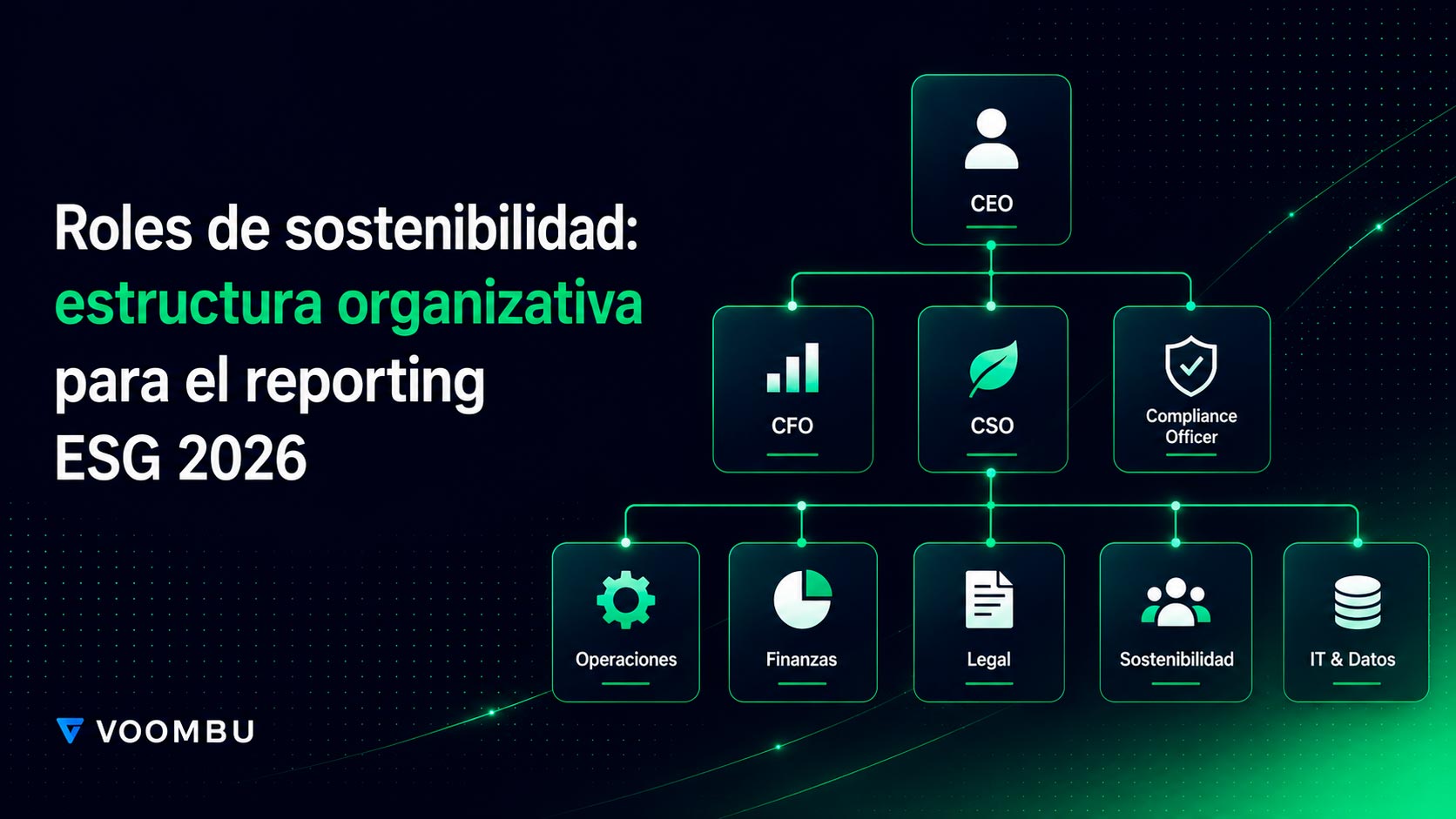
The most common barrier to CSRD compliance is not a lack of data, but the lack of a structure making clear who is responsible for each figure. When finance and sustainability teams work separately, information ends up scattered across silos, closing processes take longer and the report reaches the auditor with gaps that are difficult to justify under the ESRS standards. And there should be no illusions: with the simplification introduced by the Omnibus package, the traceability bar is not lowered, but refined.
This article is a practical guide to assigning sustainability roles thoughtfully: who captures the data, who checks it and who signs it off. The underlying idea is simple. Good governance is not bureaucracy; it organises data collection and enables non-financial statements to withstand external verification without surprises. Properly designed, it stops being an obligation and starts becoming an advantage.
Key points • The CSRD has moved sustainability from communications to the heart of governance: internal roles are now centres of responsibility, not labels. • Two roles make the difference: the ESG Controller, who brings accounting rigour to non-financial data, and the Data Owner, who is responsible for capture at source. • ESG reporting is cross-functional: Human Resources, Operations, Procurement and Finance capture indicators that previously belonged exclusively to sustainability. • Automation removes spreadsheet work and frees teams to analyse and validate rather than chase evidence. • Clear allocation of duties — with permissions and approval workflows — makes data auditable against ESRS and GRI.
Table of contents • How sustainability roles have evolved • Organisational structure for CSRD and ESRS compliance • The ESG responsibility matrix: integration across departments • Technology's role in defining responsibilities • How Voombu helps manage roles and data governance
How sustainability roles have evolved
Sustainability has stopped being a public relations exercise and entered the core of financial strategy. The European framework now requires governance in which internal roles carry legal consequences, not just operational ones. Publishing isolated data points is no longer enough: companies need traceability that can only be sustained through a clearly defined internal hierarchy.
Behind this change lies one idea: professionalising non-financial data. Companies reporting under the former NFRD have had to reorganise their teams to adapt to a much broader and more demanding CSRD, while the Omnibus package readjusts the thresholds determining who is obliged to report and when. On this shifting ground, defining responsibilities is the first step towards a report passing an audit. Without a clear chain of command, data integrity weakens and the risk of errors or omissions increases.
From voluntary compliance to a legal obligation The move to ESRS is a point of no return. One detail captures it well: management must sign the sustainability report. That signature is not a formality. It means senior management assumes legal responsibility for what is reported. A vague governance structure therefore does more than complicate indicator collection: it leaves the company exposed to regulators and shareholders who expect to trace every figure to its source.
The new Chief Sustainability Officer (CSO) profile The former environmental specialist, focused on permits and local regulations, has given way to the Chief Sustainability Officer: someone with financial vision and analytical capabilities who participates in board and risk discussions. The CSO bridges environmental impact and business value. It is a hybrid role. It combines data analysis with knowledge of sustainable finance mechanisms, and the work no longer ends with measurement. When effective, it integrates sustainability into financial planning and turns regulatory requirements into decisions that improve the company's long-term resilience.
Organisational structure for CSRD and ESRS compliance
The 2026 organisational chart leaves little room for ambiguity. To respond to the CSRD, many companies are redesigning their structures and combining technical profiles with financial capabilities so that non-financial data receives the same treatment as accounting data. The trend is to distribute the compliance workload across functions and prevent the sustainability department from becoming the sole bottleneck.
When roles are properly assigned, information travels from the plant to the final report without losing integrity. The ESG Controller acts as the hinge: translating environmental and social indicators into an internal-control language the auditor understands. Data Owners at each plant or department ensure the source data is truthful and accurate, which is where the battle is won or lost.
The role of the finance department (CFO) The CFO has moved from watching from the sidelines to leading reporting integration. Their contribution is essential to assessing financial materiality: how risks such as climate risk affect the balance sheet. Under their oversight, ESG indicators stop being isolated metrics and start influencing sustainability scoring and access to green finance. With finance involved, the report becomes a decision-making tool rather than merely a compliance document.
Data owners and information flows Traceability requires identifying and closing blind spots in operational data capture. Data owners safeguard not just the final number, but the evidence supporting it: a certificate of origin, an energy bill. That responsibility extends into the supply chain, where Scope 3 specialists coordinate with suppliers to obtain reliable impact data. Orchestrating this network is much easier with an ESG management platform that centralises flows and validates evidence automatically.
The structure is completed by the sustainability committee and ESG internal audit function. The committee validates double materiality and checks that strategy addresses the company's actual impacts. Internal audit, meanwhile, rehearses external verification: running simulations that detect weaknesses in internal controls before they become a legal or financial problem.
The ESG responsibility matrix: integration across departments
Applying ESRS requires moving from a linear structure to a matrix of connected responsibilities. Sustainability stops being a separate department and becomes a shared language across the company. When each area knows exactly what it must capture, data becomes accurate, auditable and, above all, useful for decisions. That clarity eliminates the ambiguity that often undermines the final report's quality.
Human Resources carries the weight of social indicators: the gender pay gap, training hours, equality policies. Operations and Logistics safeguard energy consumption and water-efficiency data, feeding the calculation of the Scope 1 and 2 carbon footprint. Procurement monitors the supply chain and assesses suppliers to define Scope 3. And Legal and Risk tracks regulatory developments and potential ESG litigation so that the company maintains its footing with regulators and markets.
Collaboration in double materiality analysis Double materiality is where knowledge from the whole organisation comes together. Each area identifies the impacts, risks and opportunities (IRO) within its domain and validates them using real operational evidence, not intuition. This is not passive data collection: the experts in each function decide, using technical judgement, whether a topic is material. The ESRS report then reflects what truly happens in the company rather than a superficial snapshot.
Non-financial risk management Climate and social risks are detected where activities take place, not in a central office. Mitigation should therefore be assigned to the owner of each process and documented as another everyday task. This approach enables near-real-time reporting of incidents and deviations, allowing action before an issue becomes a reputational or regulatory crisis. Integrating ESG risk into operations also improves the company's sustainability scoring.
To navigate the complexity, it helps to use ESG risk management tools that monitor materiality thresholds and issue alerts when something moves outside expectations.
Technology's role in defining responsibilities
Digitalising non-financial reporting has reshaped technical roles. Moving from spreadsheets to an integrated system lets technology handle the heaviest administrative work. This is not a cosmetic change: it makes the precision required by ESRS achievable. Centralising information on one platform breaks down silos and maintains end-to-end traceability.
This environment creates the ESG data analyst: a role combining regulatory knowledge with confidence in data management. Their job is no longer to chase evidence across departments, but to monitor the quality of information entering the system. Automation frees teams for what genuinely adds value: analysing data relevance and validating it.
Automating workflows and approvals Defining access and validation levels within the platform strengthens governance. Configuring indicator parameters greatly reduces human error and ensures every figure has documentary support. The system sequences approvals hierarchically and prepares documentation for external review. An ESRS and GRI reporting module that automates indicator capture and validation is the piece connecting everything.
From operational to strategic roles With dynamic dashboards, decisions rely on today's data rather than last year's report. Alerts detecting indicator deviations before they become compliance problems encourage teams to anticipate issues. The focus shifts from collecting data to improving performance, and reporting stops being a burden and becomes a lever for efficiency.
How Voombu helps manage roles and data governance
Voombu acts as the technological layer organising this network of responsibilities. It is not simply a repository: its ESRS and GRI reporting module allows hierarchical role assignment, so every person — from the CSO to a plant's Data Owner — sees only the indicators and evidence relevant to them. This safeguards data integrity from capture through final consolidation.
To make data owners' work easier, the platform connects directly to sources such as ERP or human resources systems. That integration removes friction from metric collection and gives teams time to analyse. The supply chain module extends the same controls to suppliers, so Scope 3 data meets the standard applied to internal data. And everything is recorded: each change is saved in an activity log, providing the documentation required for external review.
A SaaS solution that adapts to your organisation Configuration follows each client's structure. With modules such as the carbon footprint calculator (Scopes 1, 2 and 3) or double materiality analysis, Voombu simplifies processes that previously consumed hundreds of hours of manual administration. The system generates dynamic sustainability scoring so management can follow indicator progress and turn data into useful decision-making information.
Compliance as an advantage, not a burden Compliance need not be an administrative weight. When a company professionalises its reporting structure and clearly defines internal roles, it demonstrates control and transparency, which matter when attracting investment and negotiating better green financing terms. One important distinction is worth remembering: Voombu does not certify or audit; it prepares the report for verification by an independent third party. That independence is precisely part of the value.
If you want to see how Voombu can organise your ESG reporting structure and prepare your reports for the requirements of 2026, contact us and we can discuss your specific case.
Leadership and rigour in the new reporting era
Sustainability in 2026 calls for leaving reactive management behind. Clearly defining roles and establishing a cross-functional responsibility matrix are currently the best ways to guarantee non-financial data integrity. When sustainability objectives align with financial rigour, compliance stops being a cost and starts demonstrating strength to investors and regulators.
Technology is the enabler. An architecture that centralises governance, breaks down silos and automates evidence validation — with an ESRS and GRI reporting module, a footprint calculator covering all three scopes, and a risk management and scoring system — keeps documentation ready for external review. That is the starting point for leading transparently rather than trailing behind regulation.
Frequently asked questions about ESG roles and governance
What is an ESG Controller and why does the role matter under the CSRD? This technical role ensures non-financial information meets the same standards of rigour as accounting. Under the CSRD, it is essential to making reports auditable and establishing internal controls that reduce errors during data consolidation. In practice, this person safeguards the accuracy and traceability of indicators.
How should finance and sustainability collaborate? Through an integrated governance model: finance contributes analytical rigour and sustainability provides environmental and social knowledge. Both work together on double materiality and ESG risk management. This collaboration allows indicators to influence sustainability scoring and facilitate access to green finance.
What responsibilities does the board of directors have in ESG reporting? The board assumes ultimate legal responsibility for the report's accuracy and completeness and must formally approve it before publication. It oversees strategy, validates material topics and ensures the organisation has the roles needed to comply with current European regulations, accepting the legal consequences of signing.
Which roles are needed to manage the Scope 3 carbon footprint? Scope 3 requires coordination between Procurement, the sustainability specialist and supply chain managers. Together, they obtain primary supplier data and apply appropriate emission factors using a footprint calculator. Collaboration with third parties provides traceability for indirect emissions.
How does SaaS software help define sustainability roles? It allows hierarchical assignment of permissions and validation workflows for each user. By centralising information, it clarifies capture, review and approval roles and reduces the ambiguity that often causes errors. Each responsible person performs their function within a secure, auditable environment.
What profile should the person responsible for double materiality have? An analytical and strategic profile, capable of interpreting both financial risks and social and environmental impacts. They must understand how long-term value is created and coordinate experts from each area to identify material topics, always within ESRS and GRI guidelines.
Is appointing an ESG internal audit manager mandatory? The rules do not require a position with that specific title, but the CSRD does require robust internal controls and external verification. Assigning an ESG internal audit function is therefore highly recommended: it detects weaknesses before the official review and checks that Data Owners' evidence stands up to scrutiny.
How are tasks distributed in companies with multiple sites? A network model is common: a central sustainability team sets standards and local Data Owners capture information at each site. Every location has people responsible for collecting evidence, which is integrated into a single platform. This keeps global data consistent and oversight consolidated.